


 Position :
 Plastic Granulator Blade Materials: How to Choose the Right Blade?
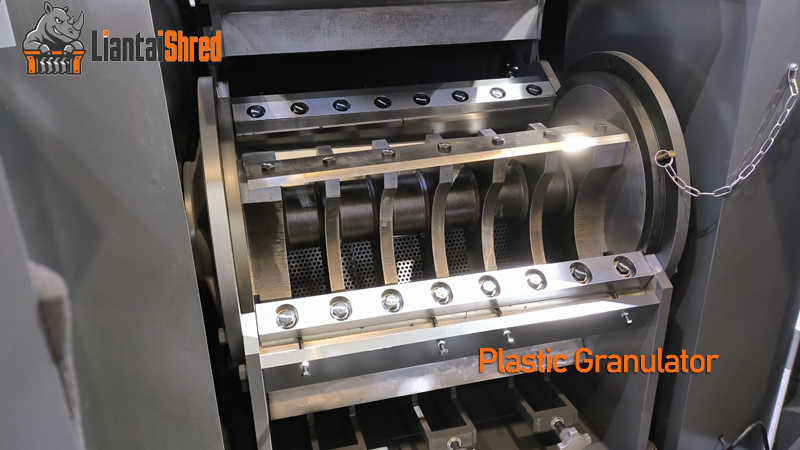
The blade material of a plastic granulator directly affects cutting efficiency, production capacity, energy consumption, particle size consistency, and blade service life.
When many customers communicate with Liantai Machinery about selecting a plastic granulator, they focus mainly on motor power, rotor size and capacity, but overlook one very important question:
“What blade material is suitable for my plastic materials?”
In fact, there is no single blade material that is suitable for all types of plastics. Different plastics have different hardness, toughness, moisture content, glass fiber content, mineral fillers and contaminants. Therefore, the blade material should also be selected according to the specific material and working conditions.
FAQ 1: What blade materials are commonly used for plastic granulators?
Common blade materials used in Liantai Machinery's plastic granulators include:
T10 / Carbon Tool Steel
SKD11 / D2 / 1.2379
H13 / 1.2344
H12
High-alloy wear-resistant tool steel
For some special applications, powder metallurgy high-speed steel or carbide-tipped blades/inserts may also be used.
Among these materials, SKD11/D2 is one of the commonly selected blade materials for plastic crushing and granulation equipment from Liantai Machinery.
FAQ 2: What are the advantages and disadvantages of T10 blades?
T10 is a high-carbon tool steel with the following characteristics.
Advantages:
Relatively low cost
Relatively high hardness
Relatively simple machining and heat treatment
Suitable for general plastic cutting applications
Disadvantages:
Lower wear resistance than high-alloy tool steels
Limited impact resistance
More sensitive to hard contaminants
More prone to rust in humid environments
Therefore, T10 is more suitable for clean, dry and relatively soft plastic materials.
For example, for common PE and PP plastic scraps with relatively few contaminants, Liantai Machinery may recommend economical blade materials such as T10.
FAQ 3: Why is SKD11 / D2 commonly used for plastic granulators?
SKD11 is a high-chromium cold-work tool steel, commonly corresponding to:
JIS SKD11 / AISI D2 / DIN 1.2379
It offers good:
Wear resistance
Hardness retention
Compressive strength
Dimensional stability
Therefore, it is particularly suitable for plastic granulators that need to operate continuously for long periods. It is suitable for materials such as:
PP
PE
ABS
PS
PVC
Engineering plastics
Plastics containing certain amounts of fillers
However, SKD11 is not stainless steel. If the material contains moisture, salt or corrosive substances, the blades may still develop rust.
FAQ 4: Is H13 suitable for plastic granulators?
H13 is a hot-work tool steel, commonly designated as:
AISI H13 / 1.2344 / SKD61
Its main characteristics include:
Good toughness
Good impact resistance
Good thermal stability
Good resistance to severe chipping
If the plastic contains a relatively high amount of hard contaminants, or if the blades are subject to high impact loads, H13 can be considered as one possible option. However:H13 does not necessarily have better wear resistance than SKD11.For long-term continuous plastic cutting, especially when processing highly abrasive materials, Liantai Machinery generally considers SKD11/D2-type materials, which often provide better wear resistance.
FAQ 5: What blade material should be used for glass-fiber-reinforced plastics?
This is a particularly important consideration.Examples include:
PA + GF
PP + GF
ABS + GF
PBT + GF
Glass fiber is highly abrasive and can significantly accelerate blade wear.For these materials, Liantai Machinery generally gives priority to:High wear-resistant tool steel / SKD11 / D2 / higher-grade alloy tool steelsThe specific material should be determined according to the glass fiber content, required capacity and machine configuration.If the glass fiber content is very high, the service life of conventional T10 blades may be significantly reduced.
FAQ 6: What should I do if the plastic material contains moisture?
If the plastic contains only a small amount of moisture, this does not necessarily mean that the blades must be changed to stainless steel.
First, we need to determine:
How much moisture is present?
Does the material contain salt?
Is it acidic or alkaline?
Does it contain corrosive chemicals?
Will the machine remain in a humid condition for a long period after shutdown?
For ordinary wet plastics, SKD11/D2 generally provides better overall performance than T10, but it can still rust.
Therefore, after shutting down the plastic granulator, it is recommended to:
Clean → Dry → Apply anti-rust protection
FAQ 7: How should the blade material be selected for different plastics?
The following table can be used as a general guideline:
Material Recommended Direction
PE T10 / SKD11
PP T10 / SKD11
ABS SKD11 / D2
PS SKD11 / D2
PVC SKD11 / D2
PET SKD11 / High wear-resistant tool steel
PA / Nylon SKD11 / D2 / High wear-resistant material
Glass-fiber-reinforced plastics D2 / SKD11 / High wear-resistant material
Mineral-filled plastics High wear-resistant tool steel
Plastics containing metal contaminants High toughness + high wear resistance
Wet plastics Prioritize wear resistance and apply proper anti-rust protection
Rubber-plastic mixtures Select according to material hardness and contaminants
The above recommendations are general guidelines rather than fixed standards from Liantai Machinery. The final blade material should be selected according to the actual material characteristics and test results.
FAQ 8: Is a higher blade hardness always better?
No. This is a common misunderstanding when selecting blades for plastic granulators.Blades need not only good wear resistance but also sufficient toughness. If the hardness is too high while toughness is insufficient, the blades may experience:
Chipping
Breakage
Blade damage
when encountering:
Metal contaminants
Hard foreign objects
Large pieces of material
Heavy impact loads
Therefore, a good blade needs to achieve a proper balance between: Hardness + Wear Resistance + Toughness
FAQ 9: What else should be considered when selecting plastic granulator blades?
In addition to the blade material, Liantai Machinery also considers:
Blade heat-treatment process
Blade hardness (HRC)
Blade thickness
Knife/tooth geometry
Rotor speed
Material hardness
Glass fiber/mineral filler content
Material moisture content
Metal contamination
Daily operating hours
Therefore, simply saying that “one material is better than another” is not a complete way to select plastic granulator blades.
So, How Do You Choose the Most Suitable Plastic Granulator Blades?
The easiest way is not to tell us: “I need SKD11 blades.”Instead, please tell us what type of plastic material you need to process.
It is even better if you can provide:
Plastic type
Material size
Moisture content
Glass fiber content
Whether metal contaminants are present
Required output size
Required capacity
Based on your actual working conditions, Liantai Machinery can recommend the appropriate blade material, hardness and blade configuration for your application.
Welcome to contact us for more detailed technical guidance and professional service.
Tel: +86-18653354363
Email: info@utmach.com